


Going back again to my first few years of teaching, I tried to be as transparent as possible by stating my learning objectives clearly on the syllabus: i.e. I listed out all the things I was going to teach students in a course. I found this very useful to help me think through each section of class content I wanted deliver to my students in my weekly and daily lesson planning. It made clear in my own head what knowledge I needed to cover for my students; in other words, I was thinking about the learning I intended my students to do in the course. But how useful is such a list of objectives in making clear to students what actual learning they are supposed to be doing?
It wasn’t until I came to the mind-blowing realization that just because I taught it, did not mean that students learned it, that I became convinced that it is more helpful to myself and my students to write learning outcomes on the syllabus instead of learning objectives.

What I wasn’t really thinking about was my students’ perspective on how my goals for the course would translate into their own learning. What most students want to know is what they will be learning, how they will show that they have learned it, and what level of learning is expected of them. In other words, I needed to reframe my learning objectives as their learning outcomes.
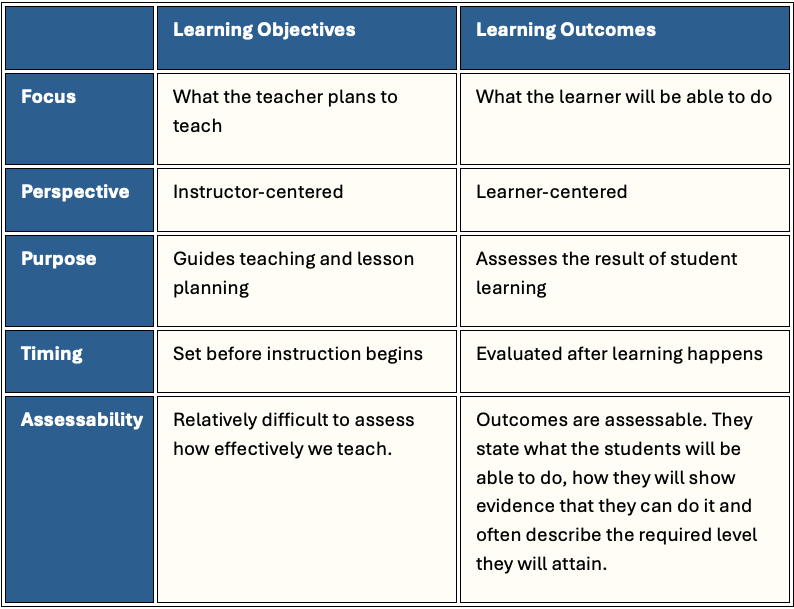
Very often, in the pedagogy literature, these 2 terms—objectives and outcomes—are used interchangeably. Faculty sometimes get frustrated with people who insist on their differences, especially when learning outcomes get tied to cumbersome accreditation processes. (See for example this dustup that played out in the Chronicle of Higher Ed in 2023 between two professors: Gayle Green and Jeremy Penn.) But it is important to think of objectives and outcomes as opposites: they are 180-degrees different from each other.
Objectives focus on the goal of instruction taken from the instructor’s point of view. Outcomes focus on the evidence that students produce to show what they have learned, and how that learning is assessed. The results rather than the intention. Objectives set the direction; outcomes show the destination. Both are important to be able to describe, but objectives are mainly for the instructor whereas outcomes are for the instructor and the students to work toward together.
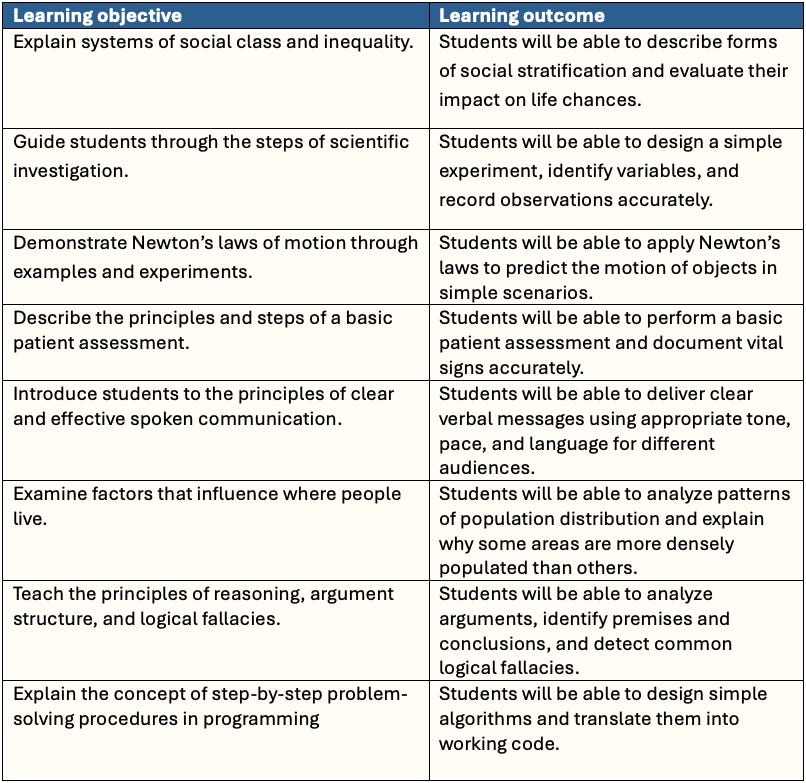
Making learning outcomes clear to the students just requires a reorientation of the language of your objectives by stating what the students will be learning rather than what you’re teaching. Consider these examples from classes in different disciplines:
Next week we will be discussing different types of learning outcomes that can be helpful for your students. I’m redesigning a discussion-based literature class right now for the fall, so I’ll be working along with you!
Resources and Further Reading:
Learning Objectives v. Learning Outcomes direct comparison table from above
Good guidelines for the evidenced-based pedagogy on building transparency into courses with learning outcomes and other means:
Mary-Ann Winkelmas, “Transparent Methods” Transparency in Learning and Teaching Project, https://www.tilthighered.com/transparent-methods
“How Transparency + Purpose in Your Course Syllabus Can Enhance Student Motivation” MIT Teaching + Learning Lab, https://tll.mit.edu/transparency-purpose-enhance-student-motivation/
The Chronicle of Higher Ed article and response mentioned above:
Gayle Green, “The Terrible Tedium of Learning Outcomes” The Chronicle of Higher Education, January 4, 2023, https://www.chronicle.com/article/the-terrible-tedium-of-learning-outcomes (PDF)
Jeremy Penn, “Essay Against Learning-Outcomes Assessment Was Myopic, Out of Touch,” February 1, 2023, https://www.chronicle.com/blogs/letters/essay-against-learning-outcomes-assessment-was-myopic-out-of-touch (PDF)
A very succinct A.I.-aided animated video-explainer by Technofys on the differences between Learning Objectives and Learning Outcomes that illustrates many of the points we make above: